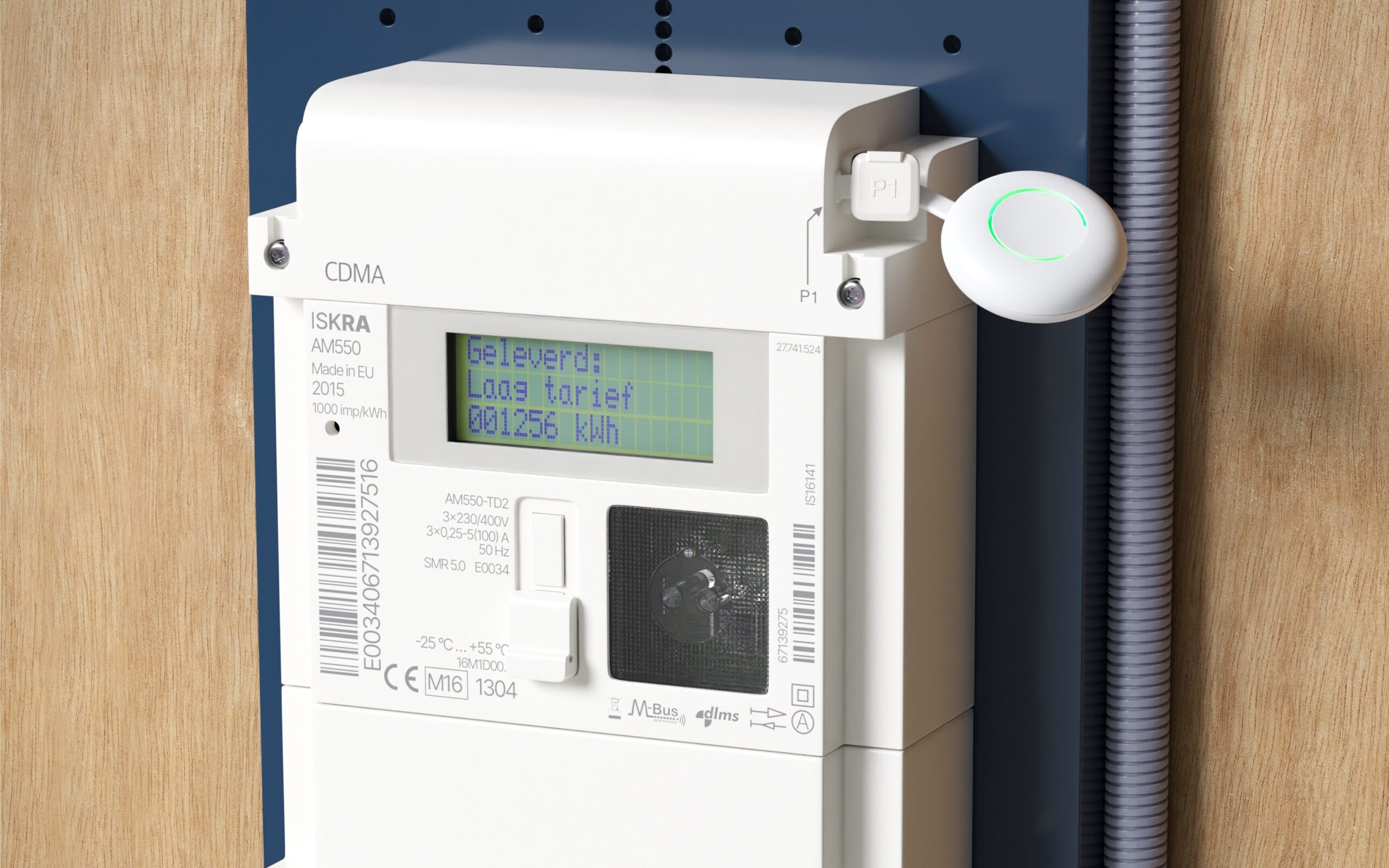
A smart meter is the most useful instrument in a Dutch household that almost nobody actually reads. It sits in a meter cupboard, blinks an LED roughly once per Wh, and reports four numbers that, taken together, describe everything your tariff cares about. This piece is a primer for the household that has never opened the lid.
kWh and kW are not the same number
The single most common confusion. A kilowatt-hour is an amount of energy — the area under the curve. A kilowatt is the rate at which you draw it — the height of the curve at this instant. A 2 kW kettle running for thirty minutes consumes 1 kWh. The same kettle running for an hour consumes 2 kWh. Your bill is denominated in kWh. Your capacity tariff, in the increasingly common case where one applies, is denominated in kW.
This distinction matters because dynamic tariffs make both numbers visible. Your supplier charges you a different per-kWh price every hour, but the bill that arrives at the end of the month is still a count of kWh — multiplied by a curve of prices rather than a single one. To know whether you are paying €0.08 or €0.45 in any given hour, you have to know which hour you are looking at.
The four readings you actually need
Open the cupboard. On the screen, cycling on a few seconds' rotation, you will see codes that begin with 1.8.1, 1.8.2, 2.8.1, 2.8.2. These are the four totals every Dutch smart meter exposes.
- 1.8.1 — Verbruik laag. Cumulative kWh imported from the grid during the off-peak window. Counts up only.
- 1.8.2 — Verbruik hoog. Cumulative kWh imported during peak hours. The split between 1.8.1 and 1.8.2 only matters on a double-tariff contract; on a single-tariff or dynamic contract, the two add together.
- 2.8.1 — Teruglevering laag. Cumulative kWh exported to the grid during off-peak — relevant only if you have solar.
- 2.8.2 — Teruglevering hoog. The same, during peak hours.
Two readings on the way in. Two on the way out. Together they are the entire ledger of your relationship with the grid.
The P1 port — your own data, your own terms
Behind a flap on every modern Dutch smart meter sits a small RJ-12 socket: the P1 port. It speaks a plain-text protocol that emits a telegram every second on older meters, every ten seconds on newer ones. The format is standardised; the data is yours.
This is the layer that matters for anyone running a dynamic tariff. Your supplier sees your consumption in fifteen-minute slices, after the fact. The P1 port lets you see it now — instantaneous power draw, current price, and the running total — in your own software, with no cloud round-trip. A €40 reader plugs into the port and pushes a stream of readings to your home network. From there, anything is possible: automations that defer the dishwasher when the price spikes, alerts when your morning peak crosses a threshold, dashboards that show whether your last heat-pump cycle paid for itself.
What "instantaneous power" tells you that the bill does not
The instantaneous power reading on the P1 — typically 200 to 800 W on a quiet evening, 2,000 to 4,000 W when the oven and kettle overlap — is the signal you need to turn a dynamic contract from a worry into a habit. The bill, ex post, only tells you what you did. The instantaneous reading, ex ante, tells you what to do.
Most Dutch households who switch to dynamic and then leave it find that their behaviour shifts in roughly the same way: the dishwasher migrates from 19:30 to 22:30, the EV charges from 02:00 to 05:00, and the largest single change — the heat pump's morning ramp — moves by ninety minutes. None of these decisions require an app. They require a number on a screen, and a household that has read this far.
Where to go from here
Three small steps, in order:
- Open your meter cupboard and find the four readings above. Note them, in order, on a piece of paper. You now know more about your consumption than 80 per cent of Dutch households.
- Look up your current contract type — fixed, variable, or dynamic. The four readings mean different things depending on which you have.
- If the maths of a dynamic contract intrigues you, the wizard in the navigation above takes your annual usage and runs it against every supplier's tariff curve, hour by hour.
Energy literacy is not an abstract competence. It is the willingness to open the cupboard.